Most of the groups/corporations listed in this top 10 list have a very poor track record and tend to be infamous for their exploitation of government powers. These corporations/groups have multi-billion dollar annual profits, enabling them to get away with the worst of crimes – especially in the case of Mexico and Drug Cartel warlord. The only way to fight the corruption of these companies is to boycott them and to put pressure on our governments to intervene.
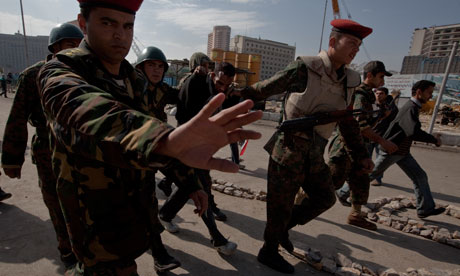
1. Egypt and the army
How powerful is the Egyptian army? Did you also know the sky is blue? Well the Egyptian army is one of the most powerful military forces in the world, but it also has another surprising function: They are one of the biggest corporations functioning in Egypt. You see, during the Egyptian revolution of 1952, the army started quickly expanding. They hired thousands of soldiers, bought heaps of equipment, constructed new military bases, and basically poured all their monetary resources into the army. After the revolution, the government had two options. 1: Fire all the surplus soldiers and flood the job market with uneducated and untrained youths, possibly causing a recession and/or another revolution when these people who only know how to be soldiers cannot get jobs, or 2: Keep pouring vast sums of amount of money into the army for no discernible purpose. And since, they couldn’t just go invade some Middle Eastern nation for fear of losing; the government came up with an idea: Keep them all on as soldiers and just use them to build things! That’s why today somewhere between 33-45% of the Egyptian economy is run by the army. The army manufactures TVs, refrigerators, bottled water, washing machines, and that is just a few this top 10 list mentions.
You may remember during the latest Egyptian revolution that the army was “refusing” to open fire on protesters. Or maybe you saw the pictures that dispersed on the internet of soldiers and protesters standing around talking to each other and not doing what Mubarak wanted them to. It was a tear jerking scene to be sure. But… did you ever wonder why the army refused to get rid of the protesters? It was because they were afraid of losing their customers. In fact the army forced Mubarak to step down because the protests were making them lose money. And don’t think the revolution changed that. If anything, the armies seized even more power.
Quote: “ So far, the Egyptian military has largely sided with the protesters in the streets of Cairo. This is not only because the military supports the people; it’s also because the military sells the people lots of stuff.”
2. Russia and Gazprom
If you are from Eastern Europe, you will almost certainly make out the word Gazprom. They are Russian exporters of natural gas, notably to European countries. What you have not heard is that this company single-handedly funds the entire Russian government and is the sole reason Putin is still the most powerful person in the country. Gazproms extravagant spending sprees (on government orders) are pushing the Russian economy forward.
They also use their substantial clout to damage and distort nearby governments into paying way more for fuel. This is most evident in Ukraine where the government pays triple the price for fuel from them, and owes Gazprom so much money that there are fears they are becoming Russia’s satellite state, refusing to say no to Gazprom and by extension Russia if they ever start asking to get paid.
If this trend continues in Russia, Putin will lose all of his power that he has wielded for years. 2014 appears to be the year things will be going down, according to current trends. God only knows what will happen then (smart moneys on China-style communism).
Quotes:
“Under Putin’s control, Gazprom has been a principal driver of the rest of the Russian economy, generously spreading rewards and high-paying contracts to Kremlin favorites. It employs nearly half a million people, working in cities and towns in every region of Russia.”
“He [Putin] has wielded Gazprom as a blunt weapon against Ukraine, where corruption has provided the company with rich opportunities to assert influence and to manipulate huge amounts of cash. Ukraine’s large storage facilities and its role as a transit nation through which most of Gazprom’s exports flow have given rise to layers upon layers of middlemen who take their cut. The country itself is Gazprom’s biggest foreign buyer and pays a higher price than any other customer. Ukraine’s debt to Gazprom is growing so large that politicians and analysts worry the country will be drawn tightly into Russia’s orbit”.
3. Mexico and the Teacher’s Union
You’ve probably heard that the American teachers union is a way too powerful organization that shields bad teachers from being fired and demanding extra benefits. However they are nowhere near as bad as the Mexican teachers union which is the single biggest union in the entire country. They have a president who through a lifetime of work for the union has collected a huge amount of moneys, mansions in Mexico city, owns a private jet, and wears clothing that would make Paris Hilton sincerely envious. And since she has such control over the political system (she controls nearly 1.2 million votes) trying to stop her is basically a “political suicide”. And the government goes to the limits to make sure their teachers don’t get fired. There are over a 100,000 teachers in Mexico who are getting the big bucks despite not going near a school in years.
The worst moment in history: Mexican drug cartel leader “La Tuta” Fomez who has a warrant out for his arrest and a multimillion dollar bounty on his head for information leading to his arrest, still receives cheques from the Mexican government because he was a teacher 15 years ago. That’s how impossible it is to fire a teacher in Mexico! You can be a drug dealer, who hasn’t shown up for work in 15 years and have a multimillion dollar bounty on your head and Mexico cannot and will not fire you.
Quote:
“The extent of Ms Gordillo’s political power has recently been revealed in more detail. Last week La Maestra confirmed the long-circulating rumour that before the 2006 election she made a “political arrangement” with Felipe Calderón, now the president, that she would back his candidacy in return for his agreement to appoint allies of hers to posts in the government. Mr Calderón, who won by the narrowest of margins, duly obliged, appointing Miguel Ángel Yunes to head the ISSSTE, the social security agency that deals with public sector workers, including teachers.”
4. South Africa and DeBeers
Social conservatives are often criticized for being more concerned by the actions of corporations which transgress doctrinal Christian no-nos, and support abortion or homosexuality. What about old-fashioned business immorality? Are we, social conservatives but also economic conservatives, blind when it comes to their transgressions?
DeBeers is a corporation that was set up by Cecil Rhodes, the British explorer and adventurer who gave his name to the African country of Rhodesia (now known as Zimbabwe).
The purpose of DeBeers was to develop and to exploit the use of diamond mines in South Africa. The challenge was that, while diamonds were a rare resources only a couple of centuries ago, the discovery of extremely rich mines in South Africa and other countries of Africa are now pushing the prices down. The establishment of DeBeers consisted therefore, in a parallel effort, of setting up a cartel with other producers in order to control international prices of diamonds.
A cartel is a group of people, organizations, or companies which coöperate to control means of production, marketing, and pricing of a product. Under antitrust laws in many regions of the world, cartels are clearly illegal, because they cut fair market competition.
The whole concept of a cartel is exactly the reason US passed the Sherman Act. Cartels are immoral because they overcharge the buying public by unnaturally propping up prices. They victimize the general buying public. They are also against the freedom of enterprise for they force possible competitors to obey the cartel directives, often under financial or even physical threats; they are oppressing their co-producers and suppliers.
Naturally the issues of the quality of products and truth in advertising are all rolled together into the issue of the victimization of the buying public. Products of a given quality are much too expensive for what they could be if the prices were allowed to be set by the market forces. Any advertising claims are relying on the concept that the products are attractive at their offered prices, and attractive for different psychological reasons for the buyers. It the prices are not morally set, the whole advertising exercise is an effort in deceit.
The DeBeers operation is undoubtedly unethical not only towards the end buyers, the public which buys diamonds, but also to all distributors and retailers of diamonds in the whole world.
DeBeers is corrupt also because it is guilty of aiding and abetting the evil operations of a whole political system, South Africa’s Apartheid system. Out of this system DeBeers has drawn two advantages: one with its labor force which had to comply with its harsh managerial policies and two by unwarranted enrichment when it took over corporations which were driven out of business through no managerial errors of their own.
In Morocco, the king pretty much controls all the businesses. But the king does not really want to own these businesses. So he distributes them as presents. He gives thousands of businesses away to common subjects. Peasants mob him wherever he goes with handwritten letters, asking him to give them ownership of corporations. If he’s in a good mood, he complies. If not, he throws them away. This “generosity” is part of the reason Morocco managed to keep out the Arab Spring
Quote:
“The powerful monarch has given companies as gifts to thousands of his subjects and in a country where unemployment hovers around fifteen percent, such a gift is prized by millions. Popular Moroccan singer Latifa Raâfat is one of almost 4,000 Moroccans given a bus company by the king.”


He is the chairman and chief executive officer (CEO) of Apple. His career spans 30 years as the Apple Inc. founder. He is well renowned for having initiated the PC era back in 1977 and the first graphical user interface that has been the platform for other software developers. Other developments he is well renowned for include creating the first DTP software and laser printer. Currently he’s innovations are well entrenched in the consumer electronic goods, i.e. iPod and iPhone.
Ropert Murdoch is the chairman and CEO of News Corp. The company is well known in the film, print and online industries. Having recently acquired the Dow Jones, his value is estimated to be in billions. His career in corporate business world can be traced back to the 50s when he inherited two major Australian newspapers. Thereafter, he expanded his emperor to the United States and Britain. If you are familiar with Sun and New York Post newspapers, they are a few of his valuable possessions.
Lloyd Blankfein is the chairman and CEO of Goldman Sachs has been accredited to having guided Goldman to success after success while other corporate organizations were reporting loses.
Eric Schmidt and Sergei Brin are co founders of Google, the worlds largest search engine. When it comes to profits generated by advertising, no other business entrepreneur reaps what the two business personalities get each year. Other than the internet industry, the two have ambitions to claiming stake in altering mobile telephony and fixing the current climatic disasters. Whereas, many predicted that Google would not last long, the two in conjunction with their witted CEO have managed to wade through misfortunes and competition that has come their way over the past decades
Warren Buffett who is the chairman and CEO of Berkshire Hathway Inc. commands respect everywhere that he goes. Leading business personalities are known to consult him on delicate business matters and are known to have been involved in some of the biggest mergers. What makes Warren Buffet stand out from the rest is his simplicity. Most people in third world countries recognize him not for his business acumen but his generosity. He has given billions of dollars to charitable organizations worldwide in a bid to alleviate poverty.
Eleanor was a part of the wealthiest family in Europe thousands of years back. She received a massive inheritance which came along with a title after her father passed away. This is when she became an autonomous ruler. She played a major part in developing Aquitaine and transformed it into a major cultural centre. Eleanor went on to become Queen in 1137.
Hatshepsut will go down in history as the most influential woman as far as Egyptian history is concerned. According to records, she was the most admirable and tolerant at the time and ruled independently till she died.
Maria Theresa of Austria was born in 1717 and she became an empress in 1740. This powerful woman modified her empire in many ways and recruited soldiers to the existing army. She also changed the face of the Government and her efforts bore fruit when the economy flourished in front of her eyes. She abolished many evil practices and spread awareness about various subjects.
Empress Theodora was an actress before she married Emperor Justinian I. She and her husband looked over the functioning of the empire but mostly all the decisions were made with Theodora’s blessing. She also supported her husband and helped the country win many battles. Not only that, but she also created awareness about the importance of women’s rights.
Empress Wu Zetian was very firm and made all the decisions when her husband was on his death-bed. She soon became the Emperor of China and put an end to the Tang Dynasty and gave rise to the Zhou Dynasty. She was ruthless in many ways and managed to spread Buddhism as a religion.
Huffington Post was founded in 2005 and managed to gain instant acceptance among those who wanted to read well-written posts about political issues. Fondly referred to as HuffPo today, it is the most powerful of its kind, according to The Observer. The blog is peppered with thoughtful and contemplative commentary that is easy to read and follow.
Lifehacker features certain tips that readers can follow if they want to ‘get things done’. It is considered to be a survival guide for those who are trying to fight against the problems that the recent economic meltdown has dragged in. The blog also helps bloggers formulate a new and improved resume for the future and digital devices are given great coverage as well.
Metafilter or MeFi is a blog which is basically an encyclopedia of such information that is both useless and shockingly useful at the same time. The bloggers keep in touch through the blog and send tips and techniques back and forth as and when they please. Arguments and discussions crop up from time to time but it is all about having fun at the end of the day!
Andrew Sullivan founded this blog in the latter half of the year 2000. When the September 11 attacks broke out, The Daily Dish was widely read by internet users on a daily basis. He covers a variety of issues ranging from political and current events to homosexuality and the legalization of soft drugs.
Stephen Dubner wrote a book by the same name in 2005 and once the book became a part of the best-sellers list, he started this blog. He explains that everything and anything that we experience in daily life is related to economics and can be explained away with the help of specific economic theories.


