Tag Archive | "history"

Top 10 Embarrassing Moments in Political History

1 2

If you were to ask Miles and Harry, from the series Grass Roots, if politics was anything more than a giant board game being played in a global arena, they would probably agree with you. Even those who have little  or no power understand that politics is not that different from board games like Monopoly or Chess. Despite its nuanced nature, politics has a strict set of rules, just like any game of chess, and can be played in as many ways as there are players – yes I mean it metaphorically. And, most importantly, like all games, the integrity of its players is constantly changing and so are the people that are playing the game with them. Every move is closely watched, analyzed, and ultimately, judged.

Whether caught on paper, photograph or television, political blunders are a major part of history, finding their way into the hands of the people and often devastating the careers of the politicians. Here are 10 examples of political “oops” starting in the United States.


1. George H.W. Bush, Bad Sushi 

Let’s give this guy a break, he had a tough presidency and that probably explains why he forgot his manners and his etiquettes when visiting Japan with his wife Barbara.

But George H. W. Bush couldn’t really help himself – he was ill when he was eating dinner in Japan. During a visit to Tokyo in 1992, the former US President vomited on Japan’s  Prime Minister Kiichi Miyazawa before slumping into an comatose state. Thanks to Barbara Bush’s attentiveness and table-hopping Secret Service agents, Papa Bush recovered quickly.

“The President is human,” said Marlin Fitzwater, a spokesperson for the Whitehouse. “He gets sick.” Even so, the dinner’s awkward and revolting amusement couldn’t be erased. It’s never polite to throw up on your hosts, no matter how ill you are.

But that’s not the only reason why Papa Bush made it to number one this Top 10 List.

During the 1988 presidential campaign, George H W Bush made an iniquitous pledge not to raise taxes, which he failed to keep after being elected.

And I’m the one who will not raise taxes. My opponent now says he’ll raise them as a last resort, or a third resort. But when a politician talks like that, you know that’s one resort he’ll be checking into. My opponent, my opponent won’t rule out raising taxes. But I will. And the Congress will push me to raise taxes and I’ll say no. And they’ll push, and I’ll say no, and they’ll push again, and I’ll say, to them, ‘Read my lips: no new taxes.’
- George H. W. Bush, at the 1988 Republican National Convention

Some political scientists argue it helped Bush win the election. Then in 1990, the recession began and things took the turn for the worst. Bush initially resisted pressure from the Democrat-controlled Congress, but eventually had to raise taxes and go back on his word.  Oops…

The issue was initially swept away by the events of the Gulf War, but returned to haunt Bush during the 1992 election. During a primary challenge, conservative candidate Pat Buchanan constantly reminded voters of the broken promise that Bush made. Bush won the nomination fairly easily, but in the General Election, Bill Clinton used to portray Bush as untrustworthy. Clinton won the election in a sweeping victory.

Republican politicians and pundits later said that Bush would have easily be reelected if he’d stuck to his word. On the other hand, the Democrats believed that Bush did the correct thing in raising taxes, and the mistake was making the promise in the first place.


2. Mitt Romney, Binders Full of Women

The second presidential debate – between President Obama and Mitt Romney was what scholars call a bizarre orgy of testosterone, lies, and silly jokes, with moderator Candy Crowley presiding over it. At one point, between all the over talking and Obama’s left-field mention of “gangbangers,” we believed that we were watching Steve James’s documentary, The Interrupters all over again.

But women’s issues, almost entirely absent from round one, finally came to the front burner in this debate. In the second question of the night, “Katherine Fenton, who was an undecided voter, asked Obama: “In what new ways do you intend to rectify the inequalities in the workplace, specifically regarding females making only 72 percent of what their male counterparts earn?”

Binders full of women.

For Romney, who was consistently down in the polls, it was his chance to show 50.8 percent of the country that he cared for equal rights and gender equity. He proved the country wrong!

The former governor of Massachusetts said he “learned a great deal” about gender pay inequality while building his cabinet.

“And I—and I went to my staff, and I said, ‘How come all the people for these jobs are—are all men.’ They said: ‘Well, these are the people that have the qualifications.’ And I said: ‘Well, gosh, can’t we—can’t we find some—some women that are also qualified?’ And—and so we—we took a concerted effort to go out and find women who had backgrounds that could be qualified to become members of our cabinet. I went to a number of women’s groups and said: ‘Can you help us find folks,’ and they brought us whole binders full of women.”

It was even worse for Romney because arguably the debate’s most memorable line was his comment – which was reportedly a lie.

On the same night as the debate took place, David S. Bernstein of the Boston Phoenix revealed that a bipartisan women’s group called MassGAP had prepared a binder with the resumes of qualified female candidates for cabinet positions in 2002 before the election had begun.

Anecdote on Female Employees.

Romney dug a deeper hole when it came to women’s issues.  He later chose to share an anecdote about one of his female employees and that comment did not sit well with women across the United States.

Ohio Protest.

On October 17th, Tiffany Ricci, a union organizer for the American Federation of State, County and Municipal Employees, scheduled a small protest in front of the Ohio Republican party’s headquarters where she and four other people demonstrated against Romney’s comment, while dressed in binder costumes. The photos were posted on Talking Points Memo before being re-shared on Liberty News Network and Twichy amongst others.

Elections 2012.

As counting concluded, the Republican candidate was on course to finish with a smaller total than his predecessor, after running against an unpopular president in the midst of a jobs crisis and sluggish economic recovery.

His political strategists were sharply criticized for failing to unseat Barack Obama even with a $1 billion (£626 million) torrent of cash released by new political finance laws, which had terrified Democrats.

Several Romney backers were dismayed that his advisers allowed Mr Obama to spend the summer attacking the Republican as a heartless plutocrat without striking back with their own positive portrayal.

Donald Trump, a Romney donor, criticized one of the highest-spending conservative “Super PACs”, which used new laws allowing independent groups to spend unlimited cash supporting Mr Romney.


3. Bill Clinton Impeached (1998)

Bill Clinton was impeached in 1998. He became the 2nd President in American history to be impeached after he lied under oath about his affair with Monica Lewinsky and many other women (for that matter)

Paula Jones.

The impeachment of President Clinton originated in May of 1994 with Paula Jones’ , a former Arkansas state employee,  sexual harassment lawsuit.   In her suit, Jones alleged that on May 8, 1991, while she helped to staff a state-sponsored management conference at the Excelsior Hotel in Little Rock, a state trooper and member of Governor Clinton’s security detail, Danny Ferguson, approached her and told her that the Governor would like to meet her in his suite.  Jones, saw this as an opportunity to advance in her career and took the elevator to Clinton’s room – big mistake.  There, she alleged that Clinton made a series of  aggressive moves, culminating in him pulling down his pants and exposing an erection–and then asking Jones to give him a  blow job – “kiss it”.  Jones claimed that she stood up and told the Governor, ”I’m not that kind of girl.” As she left, Clinton stopped her by the door and said, “You’re a smart girl, let’s keep this between ourselves.”  There is strong reason to believe that Jones was lying in story, as Clinton’s security guard reported that Jones seemed pleased when she left the hotel room–and that anything that happened inside appeared to be consensual.

Lawyers for Presidential Clinton argued that the Jones suit would distract him from the all-important job of his office and should not be allowed to go forward while he occupied the White House.  Clinton’s immunity eventually reached the United States Supreme Court.  The Court ruled unanimously against the President and allowed discovery in the case to proceed.  As Federal Appeals Court Judge Richard A. Posner noted in An Affair of State: The Investigation, Impeachment, and Trial of President Clinton, the Court’s “inept,” and “backward-looking” decision in Clinton v Jones, and an earlier decision by the Court upholding the constitutionality of the act authorizing the appointment of independent counsels,  had major consequences.

Monica Lewinsky.

Clinton’s affair with Monica Lewinsky was one that was devoid of significance to anyone except Lewinsky and would have remained a secret from the public, if it were not for Linda Tripp.  The public did not gain much from finding out the truth.  There would have been no impeachment inquiry, no impeachment, no concerns about the motives behind the President’s military actions against terrorists and rogue states in the summer and fall of 1998, no spectacle of the United States Senate play-acting at adjudication.  The Supreme Court’s decisions created a situation that led the President and his defenders into a series of cornered-rat behavior and produced a constitutional storm that caused American politics one embitterment after another… Not to mention that it weakened the role of  the President,  distracted the government from doing its job, and undermined the “rule of law.

How did Monica meet Bill?

Monica Lewinsky came to Washington in July 1995 to work as a White House intern.  In her first few months on the job, the aggressive and sexually attractive Lewinsky met and flirted with the President, but no opportunities for close personal contact arose,  or at least none that we know of.  In November 1995, however, Lewinsky was assigned to the West Wing and she soon found herself alone with the President of the United States.  He asked if he could kiss Lewinsky and she consented without hesitation,  Later that evening, the two would have the first of what eventually would accumulate to ten sexual encounters over a 16 month period.  After eight of the encounters had taken place, in April 1996, Clinton’s deputy chief of staff–most likely aware of the threat the young intern posed–reassigned Lewinsky to the a position in the Department of Defense. The following month Clinton told a disappointed Lewinsky he was ending the relationship, but he revived it again in early 1997.

The encounters followed a predictable pattern.  Generally they occurred on weekend mornings in and around the Oval Office, when few people except Clinton’s personal secretary, Betty Currie, would be around the West Wing.  Although many private meetings between the two involved no sexual activity, when they did they generally included Lewinsky fellating the President and the President fondling her breasts and genitalia.  On three occasions, Lewinsky performed oral sex while the President spoke on the phone.  Lewinsky told Clinton she would like to have vaginal intercourse with him, but he resisted.  He also terminated the oral sex sessions before ejaculation until their last two encounters.

When Clinton again told Lewinsky in May 1997 that their sexual relationship was over, she enlisted the President’s assistance in getting employment. Lewinsky received a job offer from U. N. Ambassador Bill Richardson several months later, but she turned it down, preferring to find employment in the private sector.  Clinton golfing buddy and power broker Vernon Jordan, acting at what he presumed to be the President’s request through Betty Currie, met with Lewinsky to discuss employment possibilities in November 1997.

Less than two weeks after Lewinsky’s name appeared on the Jones deposition list, Clinton told her the news.  He advised her that filing an affidavit might avoid the necessity of a deposition (but only, he need hardly have said, if she denied a sexual relationship), and he reminded her of their “cover story” for her frequent trips to Oval Office–that she was just delivering documents.  Two days after discussing the matter with Clinton, Lewinsky received a subpoena to appear for a deposition in January 1998.  She called Vernon Jordan, who again met with her and referred her to an attorney, who proceeded to draft an affidavit that reflected her denial of any sexual involvement with the President.

Just after Christmas, Lewinsky met up with Clinton again, raising her concern that the subpoena had requested that she bring to the deposition any gifts–and yes there were many -that she had received from him.  Although Clinton apparently informed Lewinsky that she was obligated to give the lawyers for Jones any gifts in her possession, a call came later that day from Currie, indicating that she understood Lewinsky had some items she’d like to give her for safekeeping.  Currie, in her testimony, countered Lewinsky’s version of events and claimed that the call about the presents came from Lewinsky, not her.  Currie drove to Lewinsky’s home and carted away a box of Clinton gifts and put them under her bed.

In early January 1998, Lewinsky signed an affidavit, claiming her relationship with the Clinton was non-sexual in any way.  The day after Lewinsky showed the affidavit to Vernon Jordan, Jordan made a call to Ronald Perelman, a member of the Board of Directors of Revlon, encouraging him to hire Lewinsky. The job offer from Revlon came through just two days after the affidavit was signed.

The American public first learned of allegations of a Clinton affair with Lewinsky on January 21, 1998.  The President stuck with his “deny-it-all” strategy and at one point wagged his finger in a televised interview and insisted “I did not have sexual relations with that woman, Miss Lewinsky.”  Several of Clinton’s aides (including Sidney Blumenthal) were assured by the President that his relationship with Lewinsky was non-sexual and even denounced Starr’s investigations as “a puritanical witch hunt”.

The denials from the White House continued into summer, when the President became aware of that his semen stain remained on the blue dress that Monica Lewinsky wore into the Oval Office and that Lewinsky had signed an immunity agreement with the Office of Independent Counsel.  In the meantime, Starr’s office had interviewed Secret Service agents, friends of Lewinsky, examined hundreds of emails and White House telephone records and listened to dozens of hours of taped conversations between Tripp and Lewinsky.

On August 17, 1998, the President faced a federal grand jury that was called to consider whether he committed perjury or obstructed justice, in the Paula Jones case.  Clinton maintained that while he was being as unhelpful as possible to Jones’s lawyers in his earlier deposition, he had not actually lied.  He insisted on his right to adopt a very narrow (and very odd) definition of “alone,” and stated that oral sex was not, in his opinion, “sexual relations” within the meaning of that term as adopted in the Jones case.  He conceded that fondling Lewinsky would be “sexual relations” and so, implicitly, denied the former intern’s allegation that he had fondled her breast and genitalia on several occasions.  He explained his discussion with Currie as an innocent attempt to check his recollection of facts against hers, and denied that Vernon Jordan’s job hunting efforts were in any way tied to Lewinsky’s decision to file an affidavit falsely denying a sexual relationship with the President.  The night, when his exhausting deposition was over, Clinton appeared on national television from the Map Room of the White House and admitted that  he did have a relationship with Miss Lewinsky that was not appropriate”–and to lash out at Kenneth Starr for invading his privady.  “It is time to stop the pursuit of personal destruction,” the President said, “and get on with our national life.”

Linda Tripp.

The source of the information that put Monica Lewinsky’s name on the depositio was Linda Tripp.  Tripp had served in the Bush White House, and was held over in her job when Clinton became president in 1993.  Tripp hated Clinton with a passion.  In 1996, when she considered how to expose what she considered to be West Wing scandals, she contacted a conservative literary agent and also Clinton-hater, Lucianne Goldberg. Goldberg urged Tripp to write an expose, but at that time Tripp’s concern with keeping her job caused her to reject the suggestion.

Tripp’s name came to public attention in August 1997 when it appeared in a Newsweek article where she recalled running into a White House volunteer, Kathleen Willey, shortly after Willey had been kissed and fondled by Clinton in his private office.  Willey, according to Tripp, was “happy and joyful” and the incident was “not a case of sexual harassment.”  Paula Jones’s lawyers, of course, took note of Tripp’s account–and undoubtedly determined at that time to add Tripp to their list of potential witnesses.

Months before the Willey story broke, however, Tripp learned from her then-friend, Monica Lewinsky, that she was having an affair with Clinton as well. Tripp told the reporter for Newsweek, Michael Isikoff, when he approached her to ask about Willey’s encounter with Clinton that the better story involved a White House intern, who she left unnamed.  Tripp, partly for her own self-defense and also because of a desire to damage the President’s reputation, began secretly taping her own conversations with Lewinsky with a $100 recorder she picked up from a nearby Radio Shack, which violated Maryland state laws.

During one of her taped conversations with Lewinsky in November 1997, Tripp learned that her friend had in her closet a blue dress  that still bore the semen stain from a sexual encounter with the President some nine months earlier.  Tripp called Michael Isikoff with the remarkable news, and urged that the reporter have the dress DNA tested.  Isikoff pointed out an obvious problem: even if Newsweek could somehow obtain the dress, the test would be meaningless without a sample of Clinton’s DNA–and how could the magazine get that?  Tripp, however, continued to have a lead role in preserving the semen evidence, urging Lewinsky not to have the dress dry cleaned–as she had planned–for a family occasion because it might be useful for her own “protection” and, besides, the dress made her look “really fat.”

What a good friend Tripp was! Not…Probably a high school longer.

Gennifer Flowers

But let’s not forget who first alleged to have an affair Clinton- Gennifer Flowers. Flowers came forward during Bill Clinton’s 1992 Presidential election campaign, alleging that she had had a 12-year relationship with him.  Flowers at first denied that she had an affair with Clinton, but later switched around her story.

After Bill Clinton denied having a relationship with Flowers on 60 Minutes, she held a press conference in which she played tape recordings she had secretly made of phone calls with Clinton. Clinton subsequently apologized publicly to Mario Cuomo for remarks he made about the then-Governor of New York on the tapes Gennifer exposed him with. During the press conference Flowers was famously asked  if she was planning to sleep with any other candidates before the election. However, news reports at the time speculated that the taped phone conversations between Flowers and Clinton could have been fixed.

In December 1996, Gennifer Flowers talked about her sexual relationship with Bill Clinton on The Richard Bey Show. The show was canceled the following day. Richard Bey later attributed a direct connection between the two consecutive events.

In his presidential deposition in January 1998, while denying Kathleen Willey’s sexual accusations against him, Bill Clinton admitted that he did lie on 60 minute and in fact had a sexual encounter with Flowers.  In 1998, Flowers also admitted that she had made a total net profit of $500,000 by publicizing her alleged affair with Clinton to Penthouse, Star Magazine and other news sources. In his 2004 autobiography My Life, Clinton acknowledged testifying under oath that he had an encounter with Flowers. He stated it was only on one occasion in 1977.

All I can say – poor Hilary!


Historic Significance of Impeach.

The impeachment of Bill Clinton was less popular than that of his Civil War predecessor, Andrew Jackson,  because of the nature of the alleged crimes. Clinton’s impeachment was rife with small, senseless details about his private life, including his relations with women other than his wife. The public, rightly or wrongly, did not generally regard his alleged crimes as being very serious. In Andrew Johnson’s case, there was no sexual scandal attached to the charges leveled at him. Johnson was accused of a dry, technical crime that most people outside of Congress didn’t even understand well. What they did know was that they disapproved of his policies. The Northern public (the only public that counted in some sense, since Southern states had not yet been re-admitted to the Union) cared about Johnson’s obstruction of Reconstruction plans designed by the Radical Republicans, who were popular in the North at this time.

The Senate’s Role in Impeachment.

Both Bill Clinton and Andrew Johnson had trials in the Senate, as provided for by the U.S. Constitution. To be removed from office, a two-thirds “guilty” vote in the Senate would be required. Andrew Johnson escaped this fate by a single vote, and so goes down in history as the U.S. president who has come closest to being forcibly removed from office. (For those thinking about Nixon at this point, keep in mind that he resigned the presidency. He was neither impeached nor removed.)

In the impeachment of Bill Clinton, the vote count was not nearly so close. 67 guilty votes were required to remove him from office; for the worst of the charges he received only 55. On another count the vote was 50 to 50, meaning that there wasn’t even a majority for conviction.


4. Larry Craig, Soliciting Hooker in Men’s Room

Senator Larry Craig (R-estroom) gave new meaning to the word caucus when he was caught playing around in an airport men’s room with a hooker.” Needless to say, the comedians had a field day mocking Craig, or as David Letterman called him, “The Restroom Don Juan.” Craig announced his resignation, then reversed his decision after “talking it over with guy in stall number 3″ (Conan O’Brien), angering his Republican colleagues, some of whom “stopped having sex with him” (Jimmy Kimmel). The staunchly anti-gay lawmaker denied being a hypocrite, saying, “Hey, I wasn’t trying to marry the cop in the bathroom” (Conan). Later, he was inducted into the Idaho Hall of Fame—not the entire hall, “just the men’s room” (Jay Leno).


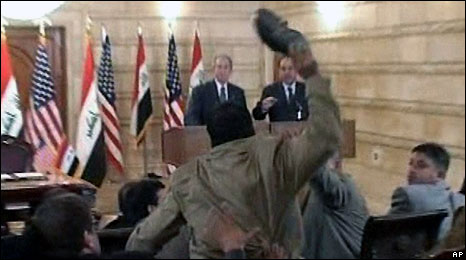
5. George W. Bush, Shoe Incident

An Iraqi journalist was arrested by security guards after he called Mr Bush “a dog” and threw his footwear, narrowly missing the president at a conference in Afghanistan.

The US president was on tour in Afghanistan inspecting troops. Earlier in the day, President Bush and Iraqi PM Nouri Maliki signed the new security agreement between their countries. The pact called for US troops to leave Iraq in 2011 – eight years after the 2003 invasion that has in part defined the Bush presidency.

Bush

If you want the facts, it’s a size 10 shoe that this journalist threw  at US President George W Bush.

It all happened so fast. Iraqi television journalist Muntadar al-Zaidi  just stood up and shouted “this is a goodbye kiss from the Iraqi people, dog,” before hurling a shoe at President Bush.

Showing the soles of shoes to someone is a sign of contempt in Arab culture. As Zaidi was evacuated, he mutter: “This is for the widows and orphans and all those killed in Iraq.”


1 2

Posted in Featured, Mis, PeopleComments (1)

Top 10 Shocking Trials Throughout History

1 2

Even though few actually say it out loud, the truth is that people have been fascinated with murder, atrocities, violence and crimes since immemorial times. Why do you think that the vast percentage of TV shows, movies, news and books often include – if they are not completely built – around murder and trials.

Irrespective of what draws people’s attention towards murder, be it the mystery of the crime itself or the fascination death exerts on us, one thing is for sure: when watching a show or reading a book regarding crimes, each and every one of us becomes captivated with the case and turns into a veritable detective. Let’s summarize the most shocking trials in history that still mesmerize people today.


1. The trial of Jesus

trial of JesusIrrespective of whether you are a religious person or an atheist, one fact remains: the Roman trial of Jesus Christ had a huge impact on the world. You just have to think about the numerous conflicts involving the believers and non-believers to realize the crucifixion was a paramount event. The mystery associated with Jesus and the way his trial was carried out is deepened by the fact that the only information people have about it comes from the Christian Bible.


2. The trials of the Spanish Inquisition

trials of the Spanish InquisitionUntil the reign of Queen Isabella and King Ferdinand, Spain was known as the most enlightened and modern empire in Europe. However, what was once the congregation of multiple cultures and faiths turned into a witch hunt aimed to enforce the Christian religion on the local Jewish and Muslim population. Even though most of the documentation involving the deeds of the Spanish Inquisition has been lost, it is said that this institution tortured and condemned to death thousands of people.


3. The trial of Martin Luther

trial of Martin LutherSoon after Martin Luther was excommunicated by the Catholic Church, he was called before an assembly of the Holy Roman Empire to defend himself. While the holy assembly was debating the arguments as to why Martin Luther does not repudiate his criticism, he ran away. Apparently, Martin Luther had a hunch about the jury’s decision, as the assembly ordered his capture and demanded a severe punishment to be enforced by the emperor.


4. The trial of Galileo Galilei

trial of Galileo GalileiThe trial of Galileo Galilei was one of the first great confrontations between the mystical realm of religion and the factual nature of science. In spite of the fact that many scholars agreed with his views and there was sufficient evidence to back up the fact that the Earth revolves around the Sun, he was trialed by the Inquisition and sentenced to house arrest. Heresy seems like a serious crime in the church’s view, considering that they admitted they were wrong and cleared Galileo’s name 300 years later.


5. The trial of Socrates

trial of SocratesBecause he always tried to challenge people’s thinking with circular and endless dialogues, Socrates was not the most popular man in ancient Athens. Perhaps, this is the main reason why he faced an unjust trial after being accused of corrupting the teens of Greece. According to some of his students (Xenophon and Plato), Socrates could have easily escaped town after the jury condemned him to death and he didn’t even try to convince the court of his innocence. Socrates preferred to remain loyal to the principle and played the role of executioner by willingly drinking poison.


1 2

Posted in EducationComments (0)

Top 10 Most Absurd Innovations In History

1 2

Certain inventions have changed the course of history by providing an efficient and convenient alternative method of handling the simplest as well as the most complex tasks. Think about electricity, combustion, antibiotics, transistors, so on and so forth. However, other “inventions” are only able to slightly alter the course of short term history, by making us laugh briefly or pondering about the mental balance of the people who patented them.

Of course, you would still have to question what exactly the clerks at the patent office had in mind when they awarded these inventions a legit status. Let’s review the top 10 innovations that won’t exactly change the world.


1. The flatulence containment pad

Flatulence containment padIn all honesty, the revolutionary flatulence pad could represent a solution of passing gas wherever and whenever without being catalogued as short-range biological weapon. This pad is inserted in the buttocks part of the pants and its role is to prevent the odor from escaping, but you will never really be comfortable with the idea that you are essentially wearing an adult diaper. At the same time, according to a customer testimonial, this thing also acts as a pretty decent muffling system. Unfortunately, the only potential achievement it is capable of is the permanent elimination of flatulence-based comic relief.


2. The bumper sensor that dissociates between pedestrian and inanimate object collision

Bumper sensorThis sensor is at least ten times less useful than the flatulence pad and why its creators actually thought it would ever come in handy is still uncertain. In essence, its purpose is to take into account several factors of the collision in order to determine whether you just hit a person, a bump in the road or a small animal. It does nothing for accident prevention whatsoever because the data it analyzes is exclusively recorded post-collision.


3. Ear cylinders for dogs and other large-eared pets

Ear cylinders for dogsIf you own a basset hound, then your biggest worry is that its ears are constantly getting into the food bowl, right? Unfortunately no, not really and if the developers of these cylinders would have actually taken a few moments to research the potential market for their invention, then the ear protection devices might have never came to be. As mentioned, their gadget is a tube – similar to the toilet paper roll one that you can always use if the dried food on your pet’s ears triggers your OCD – in which you stick the dog’s ears to prevent them from stains.


4. Surfboards equipped with jet motors

SurfboardsThe “Back To The Future” trilogy inspired invention sounds pretty cool, right? Who wouldn’t want to trip the waves with the added power of the jet engine to boost their speed? Unfortunately, while these jet powered surf boards could constitute an effective way to escape a shark attack, you wouldn’t really be able to exercise a lot of control over them, at least not until they invent electrodes that transmit the commands from your brain to the board wirelessly.


5. The glasses support system without temples

glasses support system without templesWhen you first look at the blueprints for this gadget, you get the idea that in order to support the frontal side of the frame you would have to surgically replace the ears with a couple of cylindrical magnets. The sacrifice would indeed be a step too far, so the developer thought of another “brilliant” way to get around the procedure, namely attaching the two aforementioned magnets with adhesives. Now, compared to the discomfort – not to mention the slightly ridiculous appearance – of putting up with the temples of the frame, then wearing the standard pair of glasses is a walk in the park.


1 2

Posted in BizarreComments (0)

Top 10 Influential Nations Throughout History

1 2

Throughout history, there have always been a few countries that have exerted military, cultural, technologic, economic and political dominance, on which the other nations relied upon. Even though at one point or another, such core countries are recognized as wealthy with a plethora of resources and sometimes with advantageous geographical locations, they cannot maintain their position forever. Let’s review the nations and empires that left strong trademarks in the world’s history.


1. Soviet Union

What was first perceived as a salvation army for many countries in Eastern and Central Europe, turned out to be a terrifying monster. In spite of the fact that most people associated Communism with Lenin and Stalin, let’s not forget the atrocities of the other dictators brought to power in the Soviet Union and who have systematically killed millions of civilians simply because they chose not agree with them. Yet, Communism was not only about slaughters, but also about keeping the population in constant fear and isolation from the rest of the world.


2. Nazi Germany

Despite the fact that the Nazi regime did not hold power for too long in Germany, it was a superpower at its time that has significantly affected the world as we know it. The Nazis are not only responsible for the beginning of the Second World War, but have also been the promoters of genocide and unimaginable atrocities. Even though the records speak of 4 million people killed in the Holocaust, many historians claim that the number of Jews and Eastern Europeans killed exceeds 11 millions.


3. Roman Empire

While the story of the beginning of the Roman Empire is controversial, one thing is for sure: we have the Romans to thank for the model of state prevalent today. In fact, many look back on Rome as the perfect empire where everything was fair and always working smooth. The Roman Empire was an extraordinary power in its time and its influence was felt over the centuries in Europe: simply put, Romans contributed to the development of technology, architecture, war, law, literature and the religion in the Western World.


4. The British Empire

In all honesty, the British Empire is the largest kingdom this world has ever known. Measuring over 13 million square miles and controlling over 500 million people, the British can truly be considered the rulers of the world at that point in history. Interestingly enough, the effects of the administration over a quarter of the world’s population are still visible these days as people continue to follow the political reforms, way of life and culture promoted by the British. Furthermore, English is the second most spoken language in the world and numerous linguists consider it the “de facto” standard language on Earth.


5. The Spanish Empire

Constructed mainly during the Age of Exploration, the Spanish Empire incorporated vast territories in Europe, Africa, Asia, the Americas and Oceania. However, the power and dominance exerted by the Spanish on the world only lasted a century and it was downhill all the way for them after they suffered a harsh defeat and lost almost the entire army to England. Nonetheless, Spain’s influences on the conquered territories are still visible today, two of the most noticeable ones being the Spanish language (considered the third language of the world) and Catholicism.


1 2

Posted in EducationComments (0)

Top 10 Astonishing Coincidences In History

1 2

Even though coincidences happen all the time, people perceive them as spooky mysteries when they have important consequences. Irrespective of whether they are positive (serendipity) or negative (catastrophes), coincidences have been a fascinating topic for skeptics and believers alike.

In other words, when such twists of fate take place, it makes many of us wonder about the purpose of our lives, the ultimate order of the universe and if the world is anything more than a chain of lucky accidents. Here is a top 10 list of the strangest happenstances throughout history that left many people with serious doubts.


1. The Kennedy-Lincoln Quirk

In spite of the fact that the Lincoln-Kennedy similarities are old news, it is still one of the most unusual coincidences in history. For starters, both presidents were elected at precisely 100 years apart and each was the successor of a president named Johnson, also born 100 years apart. Speaking of presidents, while Lincoln was assassinated in Ford’s Theater, JFK was shot while riding in a Ford Lincoln. Things become even more awkward when you think that Lincoln had a secretary named Kennedy, whereas JKF had a secretary named Evelyn Lincoln.


2. Archduke Franz Ferdinand’s death

As far as most people are concerned, WWI started due to the assassination of Archduke Franz Ferdinand by a Bosnian peasant though to be part of a band of conspirators. However, little is known about the fact that the assassin, Gavriol Princip gave up his plans to murder the archduke after a failed bombing attack. Apparently, during the archduke’s visit Princip was drowning his disappointment in a local café when Franz Ferdinand’s car stopped 20 feet away from him. Coincidence or not, the archduke’s driver did not only take a bad turn that day, but also managed to kill the engine while he was backing up.


3. John Lennon’s assassination

Perhaps one of the most loved artists in the 10th century was shot and killed by a schizophrenic night security guard named March Chapman in 1980. A few years after his death, when a TV station was playing a biographic movie about John Lennon the most peculiar thing was revealed: the actor playing Lennon was also named Mark Chapman. Talk about “you have got to be kidding me” coincidences!


4. Presidents Jefferson and Adams mysterious passing away

Presidents Jefferson and Adams occupy a special place in American history, not only as great leaders who shared their love for the country, both also as founding fathers who were instrumental for the implementation of the Declaration of Independence. The mystery surrounding them resides in their weirdly synchronized deaths days, which were precisely 50 years after the document was ratified (4th of July 1826).


5. The crossword puzzle and the invasion of Normandy

Two weeks before the WWII infamous D-day, London’s Daily Telegraph published a crossword puzzle containing the names of the beaches where the Ally forces would land (Omaha and Utah) along with other classified information accessible only to General Eisenhower’s staff. While initially everyone considered the author of the puzzle a Nazi spy, it turned out that all words were randomly chosen. It is quite fascinating, considering that the chances for such a thing to happen are less than 1 in a billion.


1 2

Posted in EducationComments (0)

Top 10 Mercedes Benz Models….Ever

1 2

1. The Mercedes Benz 300 SL Gullwing (1955)

The Mercedes Benz 300SL, also affectionately known as the “Gullwing”was the first “Sport Leicht”model which is a trend within Mercedes that is still alive today. Max Hoffman, an american importer, claimed to sense an market for stylish cars emerging amongst the rich and famous after the second world war. Under the hood it was based on the early racing models of the fifties being the first production car that used direct fuel injection. Its tubular frame made the Mercedes Benz Gullwing extra rigid which was crucial for control when driving at high speeds. It was these same tubes that meant the design of the doors had to open upwards instead of outwards. This then became the main signature feature of this classic motor.


2. The Blitzen-Benz (1909)

The Blitzen-Benz, also known as “Lightning-Benz”by Mercedes was a 200hp thunderbolt of a vehicle that signified the the start of the 20th century in style. The Blitzen-Benz was designed to break records. In 1909 it became the first car ever to break the 200km/h mark and then went on to hold the land speed record of 141.7mph for eight years from 1911 to 1919.


3. The Mercedes Benz C111 (1969)

In 1969 Mercedes introduced a rather unusual vehicle to the public. An experimental model by Mercedes the C111 was created to test the most innovative technologies of the time such as diesel engines and air conditioning. Its extreme “sliver”shape gave it a futuristic feel while brightly painted colours (usually yellow) covered a fibreglass body that was reinforced with plastic. The Mercedes C111’s reported top speed was 180mph.


4. The Mercedes Benz SLS AMG (2010)

First produced in 2010 the Mercedes Benz SLS AMG was described by Mercedes as the “Spiritual Successor”of the 300 SL Gullwing. The Mercedes SLS AMG is a perfect mixture of sophisticated open top driving combined with absolutely outstanding driving dynamics and a blistering top speed of 197mph. Developed by Mercedes AMG as a luxury grand tourer vehicle the SLS AMG is manufactured with Dodge Viper body panels fitted over an aluminium chassis that was developed by Dodge SRT (Street Racing Technology).


5. The Mercedes Benz 600 Pullman (1963)

In 1963, after seven years in development, we were given the Mercedes Benz 600 Pullman. Also known as the “Grand Mercedes” The engineers and design team at Mercedes were told not to worry about time or cost for the project but to create the most luxurious and best car in the world. Filled with innovation, a one-of-kind hydraulic suspension system that operates almost everything within the car. It was also the first Mercedes to ever be built in an “armoured”version as it was sold to governments worldwide. It also boasts the loudest horn ever manufactured on a production vehicle.


1 2

Posted in AutoComments (7)

Top 10 Military Technologies That Changed History

1 2

Achieving victory on the battlefield is something tricky and does not exclusively reside in the number superiority of one army or the other. While essentially winning the war implies being the last one standing, military leaders have always searched for new ways to ensure an edge over their adversaries. War tactics have constantly changed throughout history when various factions brought new ‘toys’ to the game and this list will present what I consider to be the tools that brought about major paradigm shifts in terms of battle.


1. The Egyptian chariot revolutionized ground combat

As far as history goes, all wars fought in the ancient times – particularly before 1800 B.C. – were fought by foot soldiers. Granted, all armies utilized different formations to ensure the most effective attack while maintaining an optimal level of protection for the troops, but fighting exclusively on foot is what they all had in common. Now, this shouldn’t lead you to believe that the first chariots were invented in the 1800 B.C. Archeologists have found versions of this transportation device dating from the earlier period before 3000 B.C., but the older versions were not exactly fit for battle due to their excessive weight and limited maneuverability.

The modifications made to the chariot over the years eventually lead to a perfected version that was incredibly lightweight (a single man could lift it above his head effortlessly). In addition, the wheels of the chariots were fixed with spikes, so you can easily understand why the device became incredibly popular among military powers of that time, from the western parts of Asia and all the way to Europe.


2. We have the Chinese to thank for gunpowder

You are probably familiar with the fact that gunpowder is a rather old Chinese invention, but what you probably don’t know is that its discovery was purely accidental. The first records suggest that this explosive powder was created back in 800 A.D., but kept secret by the government for almost 400 years. During this time, the Chinese were able to develop numerous varieties of weapons based on gunpowder, from cannons to bombs and anything in between. However, like all secrets, the existence of gunpowder eventually was leaked and the utilization of it in war became widespread across the continents. On a side note, gunpowder is the only reason why the Ottoman Empire was able to conquer the city of Constantinople, which seemed impenetrable until that point.


3. Gunpowder would have been nothing without rifled barrels

While it is true that gunpowder revolutionized warfare considerably, until the 1800s it was extremely difficult to have high accuracy and range with this type of weaponry. The smooth barrels of the guns determined a semi-random trajectory for long and medium distances. However, the introduction of the rifled, grooved barrels gave the bullet a rotational movement; greatly increasing the accuracy as well as the distance it could travel, not to mention the damage on impact. It is necessary to point out that rifled barrels were not utilized exclusively in hand guns and rifles, but also on the cannons mounted on warships, permitting naval battles to be carried out without even making eye contact with your opponents.


4. The internal combustion engine radically modified warfare logistics

Reinventing war is not only about coming up with more powerful weapons, but also about better ways to move them across the field of battle. From this point of view, World War I was an extremely slow paced battle, because armies relied heavily on steam engines and horses to transport troops and weaponry. The situation is completely different in the Second World War, when the introduction of the internal combustion engine permitted the rapid relocation of heavy artillery, tanks and planes, but also constituted the advent of ballistic missiles.


5. Planes brought a new component to the game

While before 1911, the only possible ways of carrying out battles was by land or sea, the Italians utilized planes in their war against Turkey not only to take high altitude photographs of the strategic positions occupied by the enemy but also to bomb them. However, these planes were relatively slow and the Second World War was the point when airplanes really proved their value in combat.


1 2

Posted in TechnologyComments (0)

Top 10 Bloodiest Battles In History

1 2

While it is true that battles win wars, overthrow political regimes and redraw the borders of nations, they also demand a lot of sacrifice and take human lives. Following is a top 10 of the bloodiest battles fought in history that have consistently reshaped the fate of nations.


1. Yorktown (1781)

The battle of Yorktown was considered by most the crucial point in the American Revolution and it is said to have directly affected the signing of the Declaration of Independence of the US. The main reason why this battle made it in the top resides in the fact the allied American army (with a little over 8,000 soldiers) and French army (with around 7,000 men) encircled and obtained a crushing victory over the British army, counting approximately 6,000 men. If it weren’t for Washington’s victory at Yorktown, it is presumed that the US would not have had the chance to develop and become the super power of today.


2. Hastings (1066)

The battle of Hastings is among the very few clashes where two similarly sized armies fought against each other. It is important to note that this battle also marks the very last invasion of England and probably less known, the first Norman invasion after the Roman conquest (1,000 years before). The outcome of the battle of Hastings has changed England’s and the world’s history with the crowning of the first king, the Norman leader William. Soon after crowning, England became more open and accepting of the political and social traditions of the rest of the countries in Europe.


3. Stalingrad (1942 – 1943)

Advertised by the Nazi regime as the greatest offense against the Soviets and with the precise role of eliminating the Russians from the WW2 once and for all, the siege of Stalingrad practically marked a long series of painful defeats. Perhaps the most ironical and inexplicable thing regarding the battle of Stalingrad was the fact that the Germans attempted to take hold of the city, despite their clear fails to capture Moscow and Leningrad. The victory of the Russians claimed a bit over one quarter of a million German soldiers and denied the access of the Nazi regime to the rich oil fields of the Caucasus region.


4. Leipzig (1813)

Although it is not nearly as known as the battle of Waterloo, the battle of Leipzig was another noteworthy success in the campaign against Napoleon and his supporters. The importance of this battle comes from the fact that it lead to the capturing of Paris and the abdication of Napoleon thanks to a great example of cooperation among the European countries. Weakened by the failed campaign into icy Russia, Napoleon and his 175,000 men stood no chance against the Allied armies counting over 300,000 soldiers.


5. Antietam (1862)

The battle of Antietam is usually referred to as one of the bloodiest days in the history of the Unites States of America. The battle against Robert E. Lee and the rebellious Confederates marked an important point in US history. Immediately after the battle of Antietam, Lincoln brought slavery to the forefront and signed the Emancipation Declaration. At the same time, the victory of the North ensured the support of the European countries, which until that point provided support for Robert E. Lee and the Confederates.


1 2

Posted in EducationComments (0)

Top 10 August Events

1 2

August is an eventful month of the year. There are specific events which occurred which deserve mention. Here they are, raise your hand if you recognize 1 or 2.


1. August 1, 1800:

The final act of Acts of Union of 1800 was adopted. The Kingdom of Great Britain merged with the Kingdom of Ireland. As of this date, it was known as the Kingdoms of Great Britain and Ireland. A new flag was created, which is still used by Great Britain.


2. August 1, 1914:

World War I begins. Germany declares war on Russia, who supports Serbia in its fight against Austria who is siding with Germany. The Alliance system crumbles.


3. August 1, 1944:

Warsaw Uprising occurs in the Nazi occupied territory. It was operated by the Polish resistance army which sought to get rid of the Nazis. This was happening at the same time as the Red Army was approaching the eastern suburbs of the city of Warsaw.


4. August 5, 1962:

Nelson Mandela is jailed for 28 years. He would not be released until 1990. His imprisonment was in response to his activism against the apartheid in South Africa. In 1944 he joined the African National Congress (ANC) which challenged the government’s apartheid policies. He was arrested in 1955 for treason but was released after trial had ended in 1961. After forming the military wing of ANC, he was rearrested and imprisoned.


5. August 6, 1945:

Hiroshima is devastated by the dropping of the nuclear bomb by the United States. 90,000 people had died as a result.


1 2

Posted in Education, FeaturedComments (0)

Top 10 July 1st Events

1 2

Ìóâè 43 ôèëüì

July 1st was a momentous day in history. Major battles were fought, decisions were made and independent countries were formed. Here are just 10 events that were major and noteworthy.


1. Battle of Boyne, 1690:

This was a battle fought during the Glorious Revolution. It was fought between two rivals of the English, Irish and Scottish thrones.


2. Battle of Gettysburg, 1863:

The Battle of Gettysburg was a battle fought during the American Civil War. The battle had the most casualties and was a turning point in the war. Robert Lee’s army was defeated at the end and the defeat caused him to end his invasion into the north.


3. Canadian Confederation (1867) & Prince Edward Island Entrance (1873):

6 years after Confederation, PEI joins Canada. It was the 6th province to enter the federal union.


4. Battle of Albert, 1916:

This WWI Battle begins on Canada Day in 1916 with the First Day of Somme. 19,000 British soldiers get slaughtered just on the first day. It later became known as the Battle of Somme.


5. Halt Chinese Immigration, 1923:

Chinese Immigration is halted in 1923. In the late 1800s, Chinese labour was used to build the Canadian Pacific Railway and to mine the new found gold. The Canadian government put a head tax on all Chinese individuals who came to Canada: $50 after the railways was finished.


1 2

Posted in Education, FeaturedComments (0)